AI Native Is a Revolution in How We Organize Work
AI does not land in companies. The reason is not friction. The reason is that the way we organize work has not changed with the technology.
Ask anyone who deploys AI in a company. They can list many reasons why it is hard: complex processes, dirty data, jobs made of 20 or 30 tasks where AI can do only some of them, staff who do not cooperate, customers who do not trust it. All these reasons are true. But they are all symptoms. A long list of symptoms does not give a cause.
The industry's answers also stay at the symptom level. Send a forward deployed engineer (FDE) to the customer site. Run training. Do change management. These are lubricants. Lubricants reduce friction. They do not change structure.
This post makes one argument. AI is a productivity revolution. Each productivity revolution in history demanded a revolution in how work is organized. "AI native" does not mean "a company that uses AI". It means "an organization that rewrote its structure for AI as a new kind of productive force". Seven points follow. Each one comes with evidence.
1. The problem is structure, not friction
Start with data. Companies do use AI. They do not get results from it.
In July 2025, MIT NANDA published The GenAI Divide. The study covered more than 300 public deployments, 52 interviews and 153 executive surveys. The result: 95% of organizations saw no measurable return on their generative AI pilots. Only 5% of integrated pilots produced value in the millions of dollars. In the same period, US companies spent 30 to 40 billion dollars on generative AI. (MIT NANDA summary, Virtualization Review)
Lead author Aditya Challapally calls the cause a "learning gap". The problem is not model quality. The problem is how companies use the models. More than 80% of companies tried consumer tools like ChatGPT. Almost 40% said they deployed them. But these tools improve individual output. They do not improve the company's profit and loss. (Computing)
The US Census Bureau's BTOS survey gives a second set of numbers. As of May 2026, 19.8% of US businesses used AI in the past two weeks. Information: 39.7%. Finance and insurance: 33.9%. Retail: about 14%. (Census Bureau, May 2026)
Put the two data sets together. The picture is clear:
- Many people use AI. Few organizations benefit.
- Individual output went up. Organizational performance did not.
- Large companies run the most pilots and convert the fewest. Mid-size companies go from pilot to production in about 90 days. Large enterprises need 9 months or more.
This is not a map of friction. This is a map of structure. Individuals use AI well because an individual does not need to change how work is organized. Organizations use AI badly because their structure was built for the previous kind of productive force.
2. AI is a productivity revolution
This point needs no argument. It only needs the right scale.
A productivity revolution starts with a general-purpose technology. It does not solve one problem. It changes the cost structure of all problems. The steam engine changed the cost of power. Electricity changed the cost of distributing power. The computer and the internet changed the cost of copying and moving information. AI changes the cost of cognitive work.
One number is enough. In November 2025, Cursor passed 1 billion dollars in annualized revenue with about 300 employees. By June 2026, it passed 4 billion dollars. Revenue per employee is far above traditional SaaS. (SQ Magazine, Dealroom) A company with a few hundred people and billions in revenue was not possible under the previous productive force.
So everyone says "AI is the fourth industrial revolution". But they say only half of it. An industrial revolution was never only a revolution in technology.
3. Each productivity revolution demands a new way to organize work
This is Marx's old thesis from the preface to A Contribution to the Critique of Political Economy. When the productive forces change, the relations of production must change with them. If they do not, the productive forces get stuck. This is not philosophy. This is economic history.
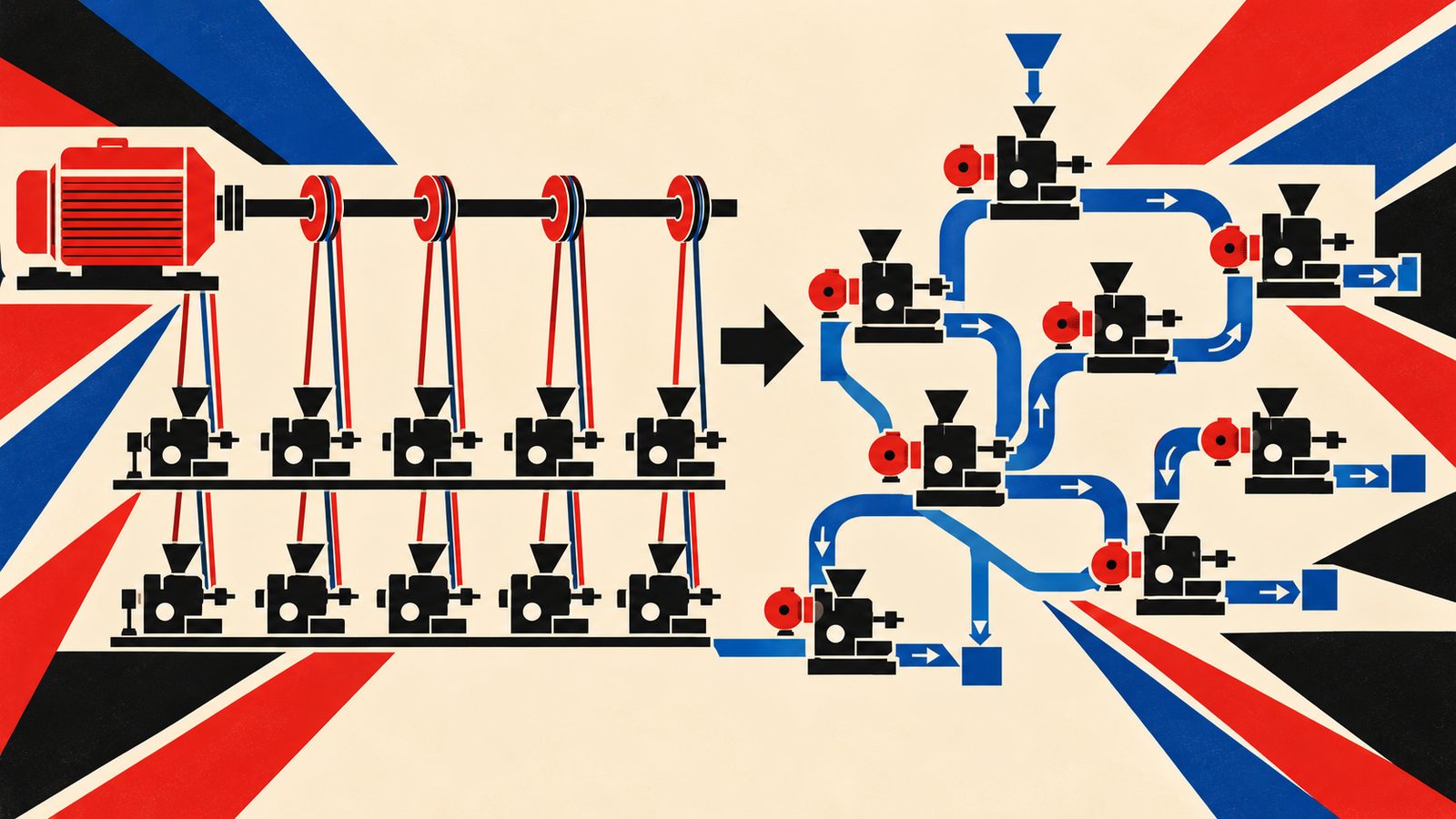
Electricity took 40 years. In 1990, the Stanford economic historian Paul David wrote The Dynamo and the Computer. He asked: the dynamo existed in the 1880s. Why did manufacturing productivity not rise until the 1920s? His answer: for the first 30 years, factories removed the steam engine and installed one large electric motor. The motor drove the same line shafts and belts as before. Factory layout, work flow and management did not change. Productivity barely moved.
The turn came when factories moved to "unit drive": one motor on each machine. The line shaft disappeared. Machines could be placed by the logic of material flow, not by distance from the power source. The assembly line became possible. Single-story plants, high ceilings, natural light and shift work all came from this redesign. By David's estimate, total factor productivity growth in US manufacturing in 1919 to 1929 was about 5 percentage points higher than in the previous decade. About half of that gain can be explained by the growth in electric motor capacity. (David 1990, PDF, HNN summary)
Note the detail. The motor itself did not change. What changed was how the factory was organized. The productive force was ready early. The organization was 40 years late.
The computer paradox. In 1987, the economist Robert Solow said: you can see the computer age everywhere except in the productivity statistics. That is why David wrote his paper. The rest is known. Productivity rose only in the late 1990s, after companies rewrote their business processes instead of putting a PC on each typist's desk.
Today's AI pilot is the factory of 1900. Connect AI to the existing job, the existing process, the existing KPI. That is "bolting the motor to the line shaft". MIT's 95% failure rate is not new. It is the standard pattern in the early diffusion of every general-purpose technology.
4. AI native is not a technology. It is a way to organize work
The term "AI native" is worn out. Most of the time it means "our product has a large language model inside". That describes technology. It does not describe an organization.
My definition: AI native is a way of organizing work that fits AI as a new productive force. Break it into four questions of "who":
- Who owns the tools — Old structure: The company buys software and assigns seats to staff. AI native structure: Compute and models are the core asset. Whoever controls the token budget controls the output.
- Who decides — Old structure: People decide, software executes. AI native structure: Agents decide inside an authorized scope. People set the boundary and audit the result.
- Who gets the output — Old structure: Pay by position and by hours. AI native structure: Pay by result. Output per person differs by 10x or more, so hours stop being a useful unit.
- Who is accountable — Old structure: The position is accountable. Approval goes up the hierarchy. AI native structure: People are accountable for the agent's boundary. Audit logs replace approval chains.
Change these four "who" questions and you are AI native. Change only the tool and you have bolted a motor to the line shaft.
Three cases below. Each shows a different attempt.
Shopify: changing "who gets the output". In March 2025, CEO Tobi Lütke sent an internal memo. He later posted it on X. One core rule: before a team asks for more headcount, it must show that AI cannot do the work. AI use became part of performance reviews. He also asked: if autonomous agents were already part of the team, what would this area look like? Shopify's headcount has fallen every year since 2022. It was 8,100 at the end of 2024. (CNBC/NBC, BetaKit) This is not a tool decision. It makes "headcount" an exception that needs a case, not a default resource. The allocation logic changed.
Klarna: new tool, old structure. In February 2024, Klarna said its AI assistant handled two thirds of customer chats, 2.3 million in the first month, equal to 700 agents. The CEO said AI could already do all their jobs. In May 2025, he told Bloomberg that quality had dropped. Klarna started to hire people again, in an "Uber-style" remote pool. (Customer Experience Dive, Entrepreneur) Many people read this as "AI does not work". I read it differently (this is my inference, not Klarna's statement): Klarna put AI into the old customer service model. Cost per conversation, tickets per agent. It changed the tool. It did not change "who is accountable for the result". Cost went down, nobody owned the outcome, and quality fell. The later "Uber-style" pool is the real structural change.
FDE: the industry's lubricant for a structural problem. The forward deployed engineer is a role Palantir invented. An engineer sits at the customer site and writes code to fit the product into the customer's processes. From January to September 2025, job posts for this role grew 800%. OpenAI, Anthropic and Google all hire for it. (Paraform, GetPerspective) FDEs are useful. I do not object to them. But the existence of the FDE is itself a diagnostic signal. If the customer's structure already fit AI, nobody would need to sit on site and bolt AI to the line shaft. The larger the demand for FDEs, the larger the structural lag.
5. The transition is messy. That is normal
In history, no new structure ever replaced the old one cleanly. The new gets surrounded, split and absorbed. It also swallows the old. This time, all three paths are already visible.
Path one: the new buys the old. Since 2025, General Catalyst, Thrive, Khosla and Elad Gil run "AI roll-ups". They no longer sell software to accounting firms, law firms and IT service providers. They buy these companies, rewrite the internal processes with AI, and use the extra cash flow to buy the next one. General Catalyst has co-founded at least ten such companies. (TechCrunch, Newcomer) The message: selling a tool does not change another company's structure. Own the company and change it directly. Software ate the world through products. AI eats the world through ownership.
Path two: old capital absorbs the new. In June 2026, SpaceX announced it would buy Anysphere, the company behind Cursor, for 60 billion dollars in stock. The deal closed in August. It is the largest acquisition of a venture-backed startup on record. Cursor's founders and investors received SpaceX shares, not cash. (TechSpot, Reuters) An AI native company with 4 billion dollars in annualized revenue became a subsidiary of a rocket company. The compute and capital it needed sat inside the old system.
Path three: frontier labs merge with the old giants. In the second half of 2025, OpenAI signed a chain of deals. Nvidia invests 100 billion dollars for 10 GW. AMD supplies 6 GW of chips and OpenAI gets warrants for about 10% of AMD. Stargate with Oracle and SoftBank is worth more than 300 billion dollars. (City AM, Data Centre Review) In April 2026, Anthropic signed a multi-gigawatt TPU agreement with Google and Broadcom. Capacity comes online from 2027. The Broadcom agreement runs to 2031. (heise, The Decoder)
These deals share one feature. Compute and power sit with chip makers, cloud providers and energy companies. A frontier lab, however advanced, must trade equity with this old capital. This is convergence. It is not a criticism. The factory owners of the industrial revolution also needed bankers.
All three paths happen at the same time. This is not a victory for one side. It is the normal state of a transition.
6. This time, the new actor may not be human
In the first three industrial revolutions, the actors of the new structure were new groups of people: factory owners, engineers, programmers. This time there is a variable with no precedent. The tool of production can make decisions and can transact on its own.
This is not science fiction. The infrastructure is being built now:
- In September 2025, OpenAI and Stripe released the Agentic Commerce Protocol (ACP). An agent can place an order inside ChatGPT.
- The same month, Google released the Agent Payments Protocol (AP2) with more than 60 organizations, including Mastercard, Visa, PayPal and American Express. Cryptographically signed mandates link a person's intent, the cart and the payment.
- Coinbase's x402 lets an agent pay in stablecoins per HTTP request.
- Visa's Trusted Agent Protocol is live. Mastercard's Agent Pay is in pilot. Their job is to identify a "legitimate agent".
(ACI Worldwide developer guide, BlockEden overview)
In other words, the payment networks are already building identity, authorization and settlement for non-human economic actors. An agent that can hold a budget, place an order and settle a payment already covers two and a half of the four "who" questions.
What this means, I do not know. Nobody knows. The factory owner of 1900 did not know the assembly line would bring unions and the eight-hour day. We should admit that we do not know, instead of pretending this is only a tool upgrade.
7. Stop asking why AI does not land
The question is wrong. It assumes AI is something to be "landed" inside the existing organization. The electric motor did not land in the line-shaft factory. It made the line-shaft factory disappear.
Ask a different question: what did we change in how we organize work, for AI?
Who owns the tools. Who decides. Who gets the output. Who is accountable. If none of the four changed, do not be surprised to be in the 95%.
Organizations that changed will not necessarily win. They may be absorbed. They may be surrounded. They may trade themselves away on the road to more compute. But they are playing this game. Organizations that did not change are still playing the last one.
References
- Paul A. David, The Dynamo and the Computer, AEA Papers & Proceedings, 1990. PDF
- MIT NANDA, The GenAI Divide: State of AI in Business 2025, July 2025. Summary
- U.S. Census Bureau, Large Firms With at Least 20 Employees Biggest AI Users, May 2026. Link
- Shopify CEO memo, March 2025. CNBC/NBC
- Klarna rehires human agents, May 2025. Customer Experience Dive
- FDE hiring trends. GetPerspective, June 2026
- AI roll-ups. TechCrunch, June 2025
- SpaceX acquires Anysphere, June–August 2026. Reuters
- OpenAI compute deals. City AM; Data Centre Review
- Anthropic–Google–Broadcom TPU agreement, April 2026. heise
- Agent payment protocols. ACI Worldwide